


Nut chamfer is an easily overlooked structural feature. This article explains the core functions of nut chamfers, common chamfer specifications, and practical selection advice for mechanical design and assembly.
1. What Is a Nut Chamfer?
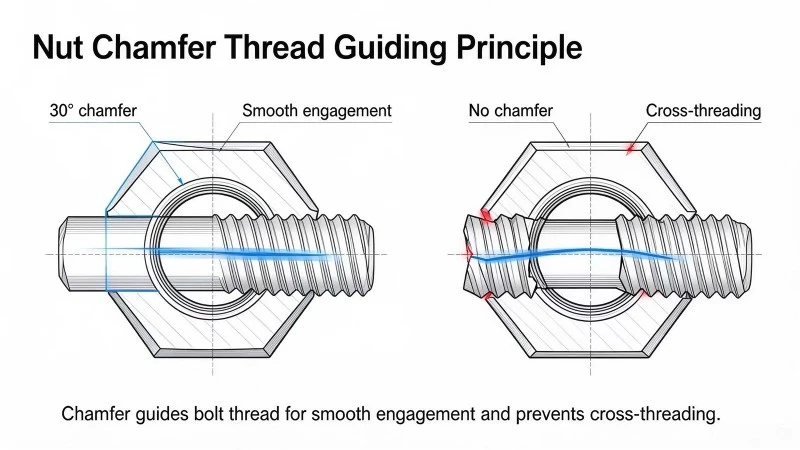
The chamfer of a nut refers to the inclined bevel machined at the top or bottom edge of the nut hole, usually at a 30° or 45° angle relative to the end face. It is not an optional decorative feature, but a standard structural requirement specified in most fastener standards such as DIN 934, ASME B18.2.2 and GB/T 6170.
Many engineers focus on thread tolerance, material grade and coating while ignoring chamfer parameters. Improper chamfer size or angle will bring hidden troubles during assembly and service.
2. Core Functions of Nut Chamfers
2.1 Guide the bolt into the thread smoothly
This is the most basic function. The inclined chamfer surface acts as a guide cone. It helps the bolt thread align with the nut thread quickly, avoiding cross-threading and thread damage during manual or automatic assembly. Without chamfering, bolt threads are very likely to hit the sharp edge of the nut and cause thread chipping.
2.2 Remove sharp burrs and prevent safety risks
Machining will leave sharp edges and burrs on the end face of nuts. Chamfering removes these sharp edges. It protects operators from scratches during handling and installation, and also prevents the sharp corner from cutting sealing gaskets, insulating sleeves or nearby cables.
2.3 Reduce stress concentration at the thread root
A sharp right-angle corner at the thread entrance will form a high-stress concentration point under preload and cyclic load. The chamfer transitions the stress gently, lowering the risk of crack initiation at the thread entry, especially important for high-strength nuts used in dynamic load conditions.
2.4 Match the mating part and avoid local point contact
When connecting with countersunk parts, washers or special joint surfaces, a reasonable chamfer can prevent the nut corner from interfering with adjacent features. It ensures full contact between the nut bearing surface and the supported component, so the clamping force is evenly distributed.
3. Common Chamfer Specifications for Standard Nuts
Most standard hex nuts adopt a 30° chamfer on the thread entry side, not 45°.
DIN 934 metric hex nuts: 30° nominal chamfer angle
ASME B18.2.2 inch series hex nuts: 30° standard chamfer
Thin nuts, jam nuts: generally retain the same 30° chamfer requirement
Special custom nuts: 45° large chamfer, double-sided chamfer or no chamfer can be made according to drawings
The chamfer depth is proportional to the thread size. Larger thread diameters correspond to larger chamfer dimensions. Excessively large chamfers will reduce the effective bearing area of the nut, which weakens the bearing capacity.
4. Engineering Selection & Application Suggestions
✅ Recommendation 1: General static mechanical connection Use standard 30° single-sided chamfer (thread-in side chamfer). It balances assembly guidance and bearing area, suitable for carbon steel and stainless steel standard hex nuts. This is the default option for most purchasing and design projects.
✅ Recommendation 2: Automatic assembly / robotic screwing production Choose a slightly enlarged standard chamfer. The better guiding effect improves the pass rate of automatic threading and reduces jamming in automated fastening stations. Do not over-enlarge the chamfer to avoid insufficient bearing surface.
✅ Recommendation 3: Vibration, fatigue and high-load working conditions Strictly follow standard chamfer dimensions. Do not cancel chamfers or use tiny, incomplete chamfers. Stress concentration caused by sharp corners will accelerate fatigue failure of the threaded connection.
✅ Recommendation 4: Nuts matched with soft gaskets, rubber or plastic parts Avoid overly sharp residual edges. A qualified full chamfer can prevent cutting and tearing of soft sealing materials under tightening pressure.
❌ Common mistakes to avoid
1.Thinking chamfer is just for appearance and asking the supplier to cancel chamfering to save cost.
2.Specifying 45° chamfer blindly for all scenarios, which reduces effective bearing area.
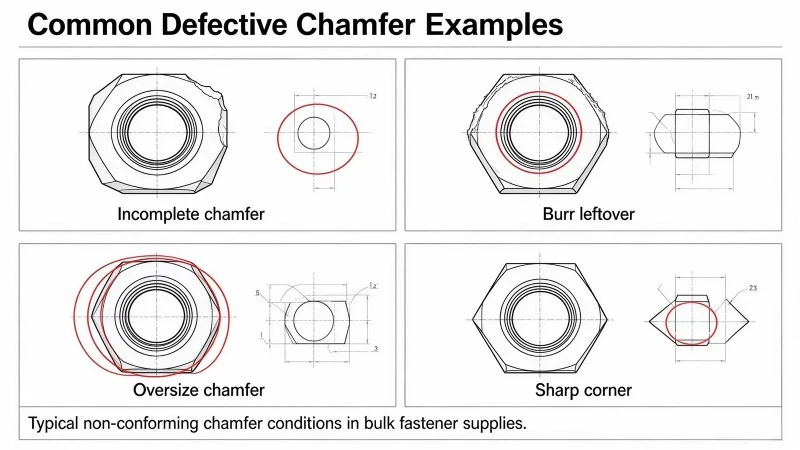
3.Accepting nuts with uneven, partial or broken chamfers from bulk shipments.
4.Confusing the chamfer side: installing the unchamfered sharp side toward the bolt.
5. Inspection Points When Receiving Nuts
When you inspect incoming nuts, check these chamfer items together with thread, hardness and surface treatment:
1.Chamfer angle conforms to drawing or standard
2.Chamfer is continuous, no missing segments or burr leftovers
3.No cracks, tearing or machining defects on the chamfer transition zone
4.Chamfer size does not exceed the upper limit that affects bearing area
6. Summary
Nut chamfering is a small but vital detail of fastener design. Its value lies in thread guiding, burr elimination, stress optimization and reliable contact. For designers and buyers, choosing the correct chamfer form according to load type and assembly method can effectively reduce assembly defects and long-term connection failure risks.