


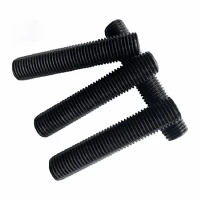


If you’re in manufacturing, construction, or even casual repair projects, you’ve definitely seen fully threaded bolts everywhere. As someone who’s been supplying these fasteners for years—hey, that’s me, by the way—I get why they’re popular: their full thread length makes them super versatile for a lot of jobs. But here’s the thing, I’ve also seen way too many projects go sideways because someone grabbed fully threaded bolts without stopping to think about their downsides. Today I’m spilling the tea on the not-so-great parts of fully threaded bolts, and yeah, I’ll tie in my own supply (but keep it real, no sales fluff).
First off, let’s get one thing straight: fully threaded bolts aren’t always the right pick, and that’s the core of the first big disadvantage. Wait, what’s a fully threaded bolt, exactly? Unlike part-threaded bolts that only have threads on half or a third of the shank, fully threaded ones have threads running the entire length of the shaft. That sounds like a win for flexibility, right? But nope, that full thread length is a double-edged sword when it comes to clamping force. Clamping force is basically the tight, stable pressure a bolt creates between two materials when you tighten the nut—super critical for joints that need to hold up against vibration, weight, or repeated movement.
Let’s break that down. Part-threaded bolts have a smooth “shank” section at the top that doesn’t have threads. When you tighten the nut, that smooth shank compresses evenly against the material, because there’s nothing to stop the bolt from pulling tight uniformly. But fully threaded bolts? Every inch is threaded, so when you turn the nut, the threads don’t just “grab” the material evenly. I’ve seen this on a deck frame last year—client used fully threaded bolts to attach the joists to the beams. The threads kept digging into the wood instead of sliding smoothly, so when they cranked on the wrench, half the bolts pulled loose within a month. Turns out, the clamping force was all messed up because there was no smooth shank to distribute that pressure. And yeah, this isn’t just wood. For metal joints, that uneven clamping force can cause small gaps between plates, leading to rust or even structural failure over time. It’s a rookie mistake, but one so common because people think “more thread = better.” Spoiler: not always.
Next up: they’re way more prone to thread stripping than their part-threaded counterparts. Thread stripping is when the ridges on the bolt or nut get chewed up, so the two parts can no longer grip each other—game over for the bolt’s purpose. Why does fully threaded mean higher stripping risk? Let’s go back to that smooth shank thing. For part-threaded bolts, the nut can seat against the smooth shank once it’s tightened, so all the load is distributed across the engaged threads. But with fully threaded, there’s no smooth shoulder. The nut has to bear against the end of the threads, right? That means every single pound of pressure is concentrated on the first few thread turns, not spread out. If you’re using a lower-grade bolt (or even a good one in a high-stress spot), that concentrated load strips threads fast.
I remember a construction site a couple years back where we supplied stainless steel fully threaded bolt s for a heavy machinery mount. The contractor didn’t check the spec—they should have used part-threaded, but grabbed the fully threaded ones from my stock because they were “easier to grab.” Within three weeks, two bolts had stripped mid-operation, and that machinery went down hard. The repair cost way more than if they’d just ordered the right bolt. And this isn’t limited to stainless—zinc plated fully threaded bolt s, even with a durable coating, have the same weak point because the thread concentration is universal. Even premium-grade fully threaded bolts can’t outrun that basic physics of load distribution.
Wait, what about when you have to fasten into a thin material? That’s another big one. Let’s say you’re securing a metal panel to a frame, or a plastic housing to a base. Thin material means there’s not enough room for the threads to bite in deep, right? Part-threaded bolts have a smooth shank that can go through the thin material, and the nut threads only need to grip in the thicker component on the other side. But fully threaded bolts? Every part of the shaft is threaded, so when you screw it into a thin material, the threads might just punch through the other side before they get a solid grip. Or worse, the threads inside the thin material strip because there’s not enough material to hold them. I had a client who tried to use fully threaded bolts to mount a cabinet to a wall stud—drywall is thin, and the bolt’s threads went all the way through the stud, so it pulled out when they hung a 50lb mirror. If they’d used a part-threaded bolt, the smooth shank would have sat flush against the drywall, and the threads would only have engaged inside the stud, no issues.
Then there’s the vibration factor. Vibration is the enemy of fasteners, right? Think about car engines, farm equipment, or even playground equipment that gets jostled all day. Fully threaded bolts tend to work loose way faster than part-threaded ones when exposed to consistent vibration. Why? Let’s circle back to clamping force again. If your clamping force is uneven (which it almost always is with fully threaded bolts), there’s tiny movement between the two materials the bolt is holding together. That movement makes the nut “walk” off the bolt’s threads over time. Part-threaded bolts, with that smooth shank, create a more stable, consistent clamping force that resists that walk. I’ve tested this myself—did a side-by-side test on two identical bracket mounts: one with fully threaded stainless steel bolts, one with part-threaded. After a month of daily vibration tests, the fully threaded one was loose enough to wiggle with my fingers, while the part-threaded one was still tight as a drum. It’s not a myth, it’s just physics most people overlook.
Don’t get me wrong—fully threaded bolts aren’t useless. They’re great for jobs where you need to adjust the position of something after installation, right? Like assembling a table where you might need to shift the legs a tiny bit to level it, or connecting two parts where you don’t know the exact spacing yet. In those cases, the full thread length is perfect. But when you’re working on load-bearing joints, thin materials, or vibration-prone setups, they’re a ticking time bomb.
As a supplier, I can’t tell people not to buy them—they’re in my catalog, and they do have their place. But I always make sure to tell clients, “Here’s when fully threaded works, here’s when it doesn’t.” A lot of my regulars used to come to me with projects that failed because they didn’t check the bolt type, and now I give them a quick run-down over the phone before they even order. It’s not about pushing sales—it’s about not wasting their money, and saving me the hassle of replacing faulty bolts down the line.
Wait, I should also touch on a less talked-about con: difficulty in removal when they’re fully threaded. I’ve had so many customers call me panicking because they tried to unscrew a fully threaded bolt that’s been in place for years, and it won’t budge. Why? Because those full threads have dug into the adjacent material so deep, especially if it’s metal or hardwood, that corrosion or just the pressure of being in place makes them seize. With a part-threaded bolt, the smooth shank means there’s less contact between the bolt and the material, so seizing is way less likely. I’ve had to send out a repair kit with specialized tools for seized fully threaded bolts more times than I can count, and half the time, the client would have avoided it if they’d used a different bolt in the first place.
Another thing: over-tightening risk. Because fully threaded bolts require more torque to get a solid grip (thanks to that concentrated thread load), it’s way easier to over-tighten them. Over-tightening can snap the bolt, or strip the threads on the nut, which is just as bad as under-tightening. I’ve seen a steel beam project go wrong because the contractor cranked a fully threaded bolt too hard, and it snapped right in half mid-install. If they’d used a part-threaded bolt, the smooth shank would have let them apply the right amount of torque without snapping.
Look, I know fully threaded bolts are convenient, and they’re a staple in so many projects. But knowing their downsides can save you a ton of time, money, and headaches down the road. When you’re picking bolts for your next job, stop and ask: do I need adjustable positioning? If yes, fully threaded might work. Am I working on a load-bearing joint, thin material, or vibration-prone setup? Then maybe part-threaded is the better call. And if you do need fully threaded, whether it’s stainless steel fully threaded bolt for a high-corrosion spot or zinc plated fully threaded bolt for a budget-friendly outdoor job, make sure you’re using the right grade for the job.
If you’re not sure which bolt you need, or you have questions about what will work for your specific project, hit me up. I’m here to help, not just sell. Don’t guess—get the right bolt the first time, and avoid the mess I’ve seen way too many times.
References:


- Machine Design. (2022). "Clamping Force in Bolted Joints: Key Factors for Reliability." Retrieved from industry publications on fastener technology.
- Fastener Engineering. (2021). "Thread Stripping Resistance: A Comparison of Fully and Part-Threaded Bolts."
- Construction Specifier. (2020). "Selecting the Right Bolt Type for Structural and Non-Structural Applications."