


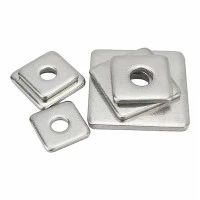
If you’ve ever stared at a mechanical assembly or a construction beam wondering “why is that little square piece here?”, you’ve probably glanced at a square washer. As a square washer supplier, I field this question at least a dozen times a week—often from engineers, builders, or weekend DIYers who know these parts are critical but aren’t sure exactly what they’re designed to hold. The load-bearing capacity of square washers isn’t a random number pulled from a spec sheet; it’s a calculation shaped by material, size, how they’re installed, and the forces they’ll face. Getting this right isn’t just about preventing broken parts—it’s about keeping projects safe, long-lasting, and free of costly delays. Let’s break down what determines a square washer’s load-bearing capacity, what to look for when choosing one, and how to avoid common mistakes that lead to washer failure.
First, let’s start with the basics: what makes a square washer different from a round washer? Round washers spread load over a circular area around a bolt or screw, but square washers have sharp, straight edges that sit flush against the mating surface (like wood, metal, or concrete) and distribute force over a larger, more rigid area. That rigidity is a huge advantage for applications where the mating surface is soft or uneven—think pressure-treated lumber, which can compress under bolt pressure, or concrete, which needs even load distribution to avoid cracking. The square shape also prevents rotation during tightening, which keeps bolts aligned and ensures consistent load transfer from the fastener to the surface below. But all those benefits depend on one key factor: how much weight or force that square shape can support before it deforms, cracks, or fails.
Load-bearing capacity of a washer is measured in two main ways, depending on the application: bearing stress (the pressure exerted on the surface the washer is sitting against) and the washer’s own tensile or compressive strength (how much force the material of the washer can handle before it bends or breaks). For most structural and industrial applications, we focus on bearing stress because that’s what leads to real-world failure. Bearing stress is calculated by dividing the total axial load (the weight or force being applied through the bolt) by the contact area of the washer. For a square washer, the contact area is simply the area of the square minus the area of the hole in the middle. A common rule of thumb from the American Institute of Steel Construction (AISC) is that steel washers should have a minimum bearing area of 1.5 times the area of the bolt shank to avoid surface crushing. But that’s just a baseline—your actual capacity will shift based on material, thickness, and quality of manufacture.
Let’s talk about materials first, because this is where the biggest variations in load-bearing capacity come in. As a supplier, we carry three primary material grades for square washers, each with distinct load ratings and use cases: zinc-plated steel, hot-dip galvanized steel, and stainless steel. Each has its own strengths and limitations, so matching material to your project’s load requirements is non-negotiable.
Zinc-plated square washers are the most common, budget-friendly option. They’re made from low-carbon steel coated in a thin layer of zinc to resist light rust, making them ideal for indoor applications like cabinetry, electrical enclosures, or light-duty machinery. What’s their load-bearing capacity? A standard 1/4-inch zinc-plated square washer (1.25 inches square, 0.06 inches thick) has a rated bearing capacity of around 2,500 pounds, while a 1/2-inch version (2 inches square, 0.12 inches thick) can handle up to 10,000 pounds. But it’s important to note that zinc plating is a thin sacrificial layer—if the coating scratches or chips, the underlying steel can rust quickly, which weakens the washer over time. That’s why zinc-plated square washers aren’t recommended for outdoor or high-moisture projects. If you’re working on an indoor, light-load project and need reliable zinc-plated options, you can browse our full range at [Zinc Plated Square Washer].


For outdoor or high-corrosion environments, hot-dip galvanized square washers are the go-to. Instead of a thin electroplated layer, these washers are dipped in molten zinc, creating a thick, uniform zinc coating that bonds to the steel surface, providing far better rust resistance. This thicker coating doesn’t just prevent corrosion—it also adds to the washer’s overall durability and load-bearing capacity. A 1/2-inch hot-dip galvanized square washer, for example, has a rated bearing capacity of around 12,000 pounds—20% higher than a comparable zinc-plated washer of the same size and thickness. That extra strength comes from the hot-dip process, which produces a denser steel core and a more robust coating that resists chipping even during installation. They’re perfect for decking, fencing, outdoor structural beams, and agricultural equipment. To see our full selection of hot-dip galvanized square washers, visit [Hot Dip Galvanized Square Washer].
When you need the highest load capacity and maximum corrosion resistance, stainless steel square washers are the best choice. Made from austenitic or ferritic stainless steel grades like 304 or 316, these washers are virtually immune to rust, even in saltwater, chemical, or extreme temperature environments. Their load-bearing capacity is significantly higher than steel or galvanized washers of the same size: a 1/2-inch 304 stainless steel square washer can handle up to 15,000 pounds of bearing load, while a 316 stainless steel version (made for harsh marine or chemical settings) can reach 16,000 pounds. That extra strength makes them ideal for heavy industrial machinery, marine construction, pharmaceutical equipment, or any project where failure could have catastrophic consequences. The only tradeoff is cost—stainless steel is more expensive upfront, but it lasts 2–3 times longer than galvanized steel, making it a better long-term investment for high-stakes projects. Our full line of stainless steel square washers is available to view at [Stainless Steel Square Washer].
Now, material isn’t the only factor in load-bearing capacity—washer size and thickness play an equally critical role. A common mistake we see is customers using a too-small washer for a high-load application. For example, a 1/4-inch bolt paired with a 1-inch square washer (instead of the standard 1.25-inch) will have a contact area 36% smaller, cutting its load capacity from 2,500 pounds to just 1,550 pounds. Thickness is also key: a 0.06-inch thick 1/2-inch washer will carry 10,000 pounds, while a 0.15-inch thick version of the same square size will handle 18,000 pounds—nearly double the capacity. That’s because thicker washers resist bending and deformation far better than thin ones, which is crucial for distributing load evenly across the surface.
But even the highest-rated washer will fail if it’s installed incorrectly. Two installation mistakes are the most common causes of washer failure: over-tightening and misalignment. Over-tightening a bolt can cause a square washer to deform or crack, even if it’s rated for the load you’re applying. This happens because tightening beyond the manufacturer’s recommended torque creates too much stress on the washer’s edges, where the square shape’s sharp corners are prone to cracking. Misalignment is another issue: if a washer is sitting at an angle instead of flat against the mating surface, the load is concentrated on one corner of the square, not spread evenly. This localized stress can cause the washer to bend or break at a load 30–40% lower than its rated capacity. To avoid this, always use a torque wrench to tighten bolts to the manufacturer’s specifications, and double-check that washers are seated flat before securing the bolt.
There’s also a common misconception that square washers are only for heavy structural applications. While they excel at high loads, they’re also useful for softer mating surfaces, where round washers can sink in unevenly. For example, when attaching a metal bracket to particle board, a square washer distributes the bolt’s pressure over a larger area, preventing the wood from splitting or compressing. In this case, a zinc-plated square washer would be more than sufficient, since the load is low and the environment is indoor. Using the wrong washer here—say, a thin round washer—could lead to the bracket pulling loose over time, which is a safety hazard for things like shelf supports or hanging mirrors.
So, how do you determine exactly what load-bearing capacity you need for your project? Start by calculating the total axial load your fastener will be under. For static loads (like a shelf holding books), this is the weight of the object plus any additional live load. For dynamic loads (like a deck supporting foot traffic or a machine with moving parts), add a safety factor of 2–3 times the calculated load to account for sudden shifts, vibration, or wear over time. Once you have that number, match it to a washer’s rated capacity, accounting for material, size, and thickness. If you’re working in an outdoor environment, bump that safety factor up to 3–4, since corrosion will gradually reduce a washer’s load capacity over time.
If you’re still unsure which square washer is right for your application, that’s where suppliers like us come in. We don’t just sell washers—we help customers navigate load calculations, material choices, and installation best practices to ensure their projects are safe and long-lasting. Whether you’re a homeowner working on a small deck, a contractor tackling a large construction project, or an engineer designing industrial equipment, we can help you find the right square washer for your specific needs.
If you’re ready to source square washers for your next project, we invite you to connect with our team to discuss your requirements, review load calculations, or request a custom quote. We offer flexible ordering for both small and large volumes, and our technical team is always available to answer questions about material grades, size specifications, and installation guidance. Don’t let a poorly sized or low-quality washer put your project at risk—reach out today to get the right square washer for your load requirements.
References
- American Institute of Steel Construction. (2016). Steel Construction Manual (15th ed.). AISC.
- Stainless Steel Manufacturers Association. (2021). Properties and Selection of Stainless Steel Fasteners and Washers. SSMA.
- Galvanizers Association. (2019). Hot-Dip Galvanizing for Corrosion Protection of Steel Components. GA.
- Wood Handbook: Wood as an Engineering Material. (2010). U.S. Department of Agriculture Forest Service.