



Products Description
Nuts primarily serve a fastening function, securely connecting two or more components by mating with bolts or screws. There are many types of nuts, each with its own specific applications. In addition to fastening, their main purpose is to protect one end of the thread from direct contact with the outside environment, preventing damage caused by friction with external objects.
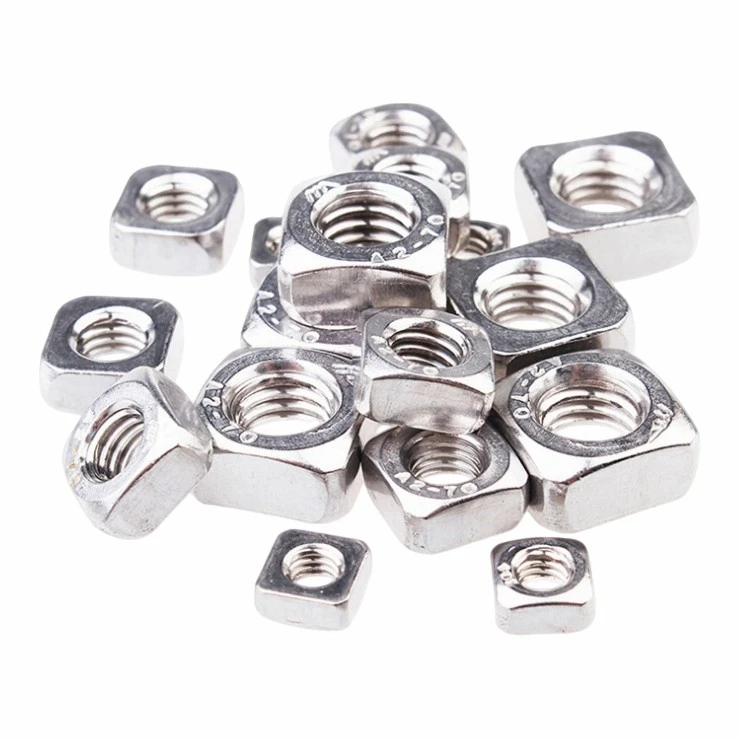
Square nuts have a square outer contour with four flat sides, rather than a hexagonal shape. Their inner bore is threaded and designed to be used with corresponding bolts. Due to their large contact surface area, square nuts offer superior anti-rotation and anti-slip performance. Once tightened, they are less likely to loosen and can be easily positioned by fitting into square slots.
Common Standards
- Chinese Standards: GB/T 39 (Grade C), GB/T 6177
- German Standards: DIN 557 (most commonly used)
- Japanese Standard: JIS B1163
- American Standard: ASME B18.2.2

Materials and Grades
- Carbon Steel: Q235, 45#; Grades 4.8, 8.8, 10.9
- Stainless Steel: 304 (A2-70), 316 (A4-80)
- Surface Treatment: Galvanized, Passivated, Blackened, Dacromet
Typical Applications
Channel Steel, Machine Frames
This is the most common application: the square nut is wedged into the groove of the channel steel. The nut is prevented from rotating by the groove walls, so tightening the bolt alone secures it-no additional wrench is needed to hold the nut in place. This method is widely used in equipment frames, steel structure supports, and shelving.
Agricultural Machinery, Construction Machinery, Mining Machinery
These applications involve high levels of vibration, so nuts with a large contact surface and excellent vibration resistance and anti-loosening properties are required. They are commonly used in agricultural machinery frames, track mechanisms, mining equipment, and heavy machinery connections.
Fixtures, tooling, and molds
Used in conjunction with T-slots, square guide rails, and workholding fixtures, they are embedded in the slot for positioning and clamping workpieces.
Lifting, hoisting, and rail accessories
Used in conjunction with square-head bolts, lifting slings, and rail clamps, these offer high load-bearing capacity and are suitable for heavy-duty applications and areas subject to frequent stress.
Construction, Guardrails, and Electrical Hardware
Commonly used in steel structure guardrails, electrical supports, and pipe hangers and brackets for outdoor equipment. The nuts are vibration-resistant and slip-resistant.
Exclusive for Square-Head Bolts
Used as a set with square-head bolts in accordance with national standards, these are the preferred choice for older equipment and heavy-duty connections.
Common Sizes for Square Nuts (DIN 557 / GB/T 39)
Unit: mm (metric coarse thread)
|
Specifications |
Pitch P |
Diagonal S |
Height m |
Weight per 1,000 pieces (kg) |
|
M3 |
0.5 |
5.5 |
2.4 |
~0.55 |
|
M4 |
0.7 |
7 |
3.2 |
~1.1 |
|
M5 |
0.8 |
8 |
4 |
~2.0 |
|
M6 |
1.0 |
10 |
5 |
~3.8 |
|
M8 |
1.25 |
13 |
6.5 |
~8.4 |
|
M10 |
1.5 |
16 |
8 |
~16.5 |
|
M12 |
1.75 |
18 |
10 |
~26.0 |
|
M14 |
2.0 |
21 |
11 |
~38.0 |
|
M16 |
2.0 |
24 |
13 |
~58.5 |
|
M20 |
2.5 |
30 |
16 |
~112 |
Imperial Sizes (Common)
- 1/4"-20, 5/16"-18, 3/8"-16, 1/2"-13
Selection Guidelines
1. Strength Matching: Nut grade ≥ Bolt grade
2. Environment: Select 316 stainless steel for humid or chemical environments
3. Space: Select low-profile square nuts for thin or narrow-flange applications
4. Anti-loosening: Use spring washers or anti-loosening adhesive in vibrating conditions
Hot Tags: square nut, China square nut manufacturers, suppliers, factory, Anchor Nut, Cap Nut, Coupling Nut, Square Nut, structural nuts, Wheel Hub Nut


